* * *
A project on Enzo Ferrari seems so natural for someone like Mann who is pretty much the most stylish filmmaker of the past thirty years or so. His films ooze an unwavering stylish elegance. A trawl back through his films and it becomes evident how well so many of his characters dress, drive and live. Style has always been more than just a decorative gesture for Mann; it carries a particular socio-political weight and has a substantial aesthetic significance that resonates in what has often been a brilliantly realised and dazzling modernist urban universe. As expected, Ferrari is a superbly crafted genre piece but it also shows Mann shifting gears, venturing into the realms of the family melodrama but also returning to the biopic and the sport film.
Ferrari was a project long in gestation and I was somewhat surprised how quickly Mann shot and edited the film but it is undeniably littered with many of the recognisable Mann touches explicitly the preoccupation and fetishization with time. The choice to focus on a specific period in Enzo Ferrari’s life, 1957, at a particular crossroad of his illustrious life smartly veers away from the pitfalls of the bloated nature of the biopic form which can often lead to following a stagnant rise and fall structure. In some respects, Mann’s 2001 film Ali comes to mind, a work that also isn’t strictly a biopic but plugs into a particular synapse of our cultural mindset regarding universal icons.
The opening sequence that establishes Enzo as a racing driver draws on archive footage and that refers back to Mann’s early film school years as a documentary filmmaker, a cinema verité style that lingers through many of Mann’s films, markedly in a work like The Insider. Enzo’s dogged commitment to racing the best he can and to win at all costs is not unfamiliar to the stoic professionalism of Mann’s male protagonists who live in a zen like state of existence; Enzo is unlike the ascetic loners that populate Mann’s crime films. The impossibility to pierce what is an impenetrable veil of privacy is somewhat absent in Ferrari but the discipline to win that Enzo channels into his drivers demands a concentration, a refusal to let one’s guard down as it means emotional attachment which creates vulnerability, a classic Mann trait.
Equivalently is the fixation with time which is altogether amplified via the competitive nature of motor racing, harking back to one of Mann’s earliest films – The Jericho Mile. The kinetics of speed is framed as both cathartic and terminal; a terrifying co-existence in which death is a near certainty, and that ultimately taints the legacy of Enzo’s achievements. But these are the flaws that Mann revels in bringing to life particularly in the adulterous schizophrenic double life that Enzo leads, mapping a betrayal that gives the work an emotional depth. Another emotional dimension uncharacteristic of Mann is the emphasis on grief that consumes both Enzo and Laura (Penelope Cruz overshadowing pretty much everyone around her). The trauma of losing a child that bears down on them, haunting them perpetually is made altogether painful with Enzo’s betrayal.
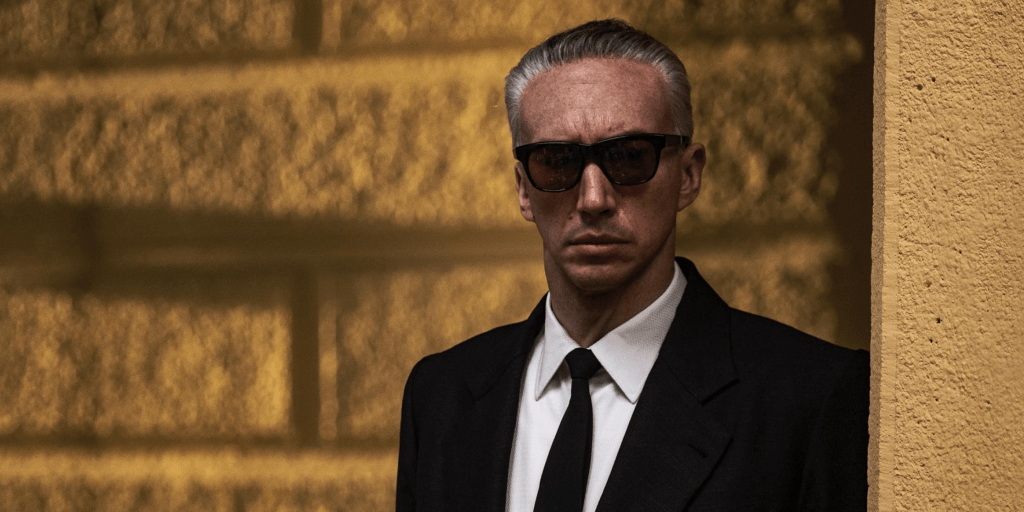
At first, I wasn’t convinced with the casting of Driver but he grows on you and Mann does something quite brilliantly to augment the performance which is to repeatedly focus on Driver’s physicality as Enzo; his lumbering frame that moves speedily across the spaces he inhabits is an extension of a kineticism that is replicated in his passion for racing while the camera constantly pushes up close to Enzo’s face, creating the classical asymmetrical disruption that characterises so many of Mann’s films. Moreover, Driver’s tall, strangely shaped body is draped in an array of finely tailored Italian suits that creates the stylish chic that often defines the outwardly modernist design of many of Mann’s men. Unsurprisingly, for all his knowledge of racing, Enzo is another Mann protagonist who is completely out of synch with the shifting realities of society, and in this case his business which is on the verge of ruin.
So many of Mann’s films crescendo luminously towards the end, regulated through a distinctive and affective audio-visual ambience, and reaching an apotheosis that is both stylish, emotional and haunting. One could argue this specific authorial refrain resurfaces in the Mille Miglia race sequence at the end of the film; Enzo’s sense of accomplishment is brought into perspective with the tragedy of Portago and nine spectators who lost their lives. The eerie voice of Lisa Gerrard on the soundtrack as Enzo inspects the carnage is a musical cue lifted from The Insider but also audible in Miami Vice, signifying an immeasurable sense of loss and finality.
 Movie Mahal