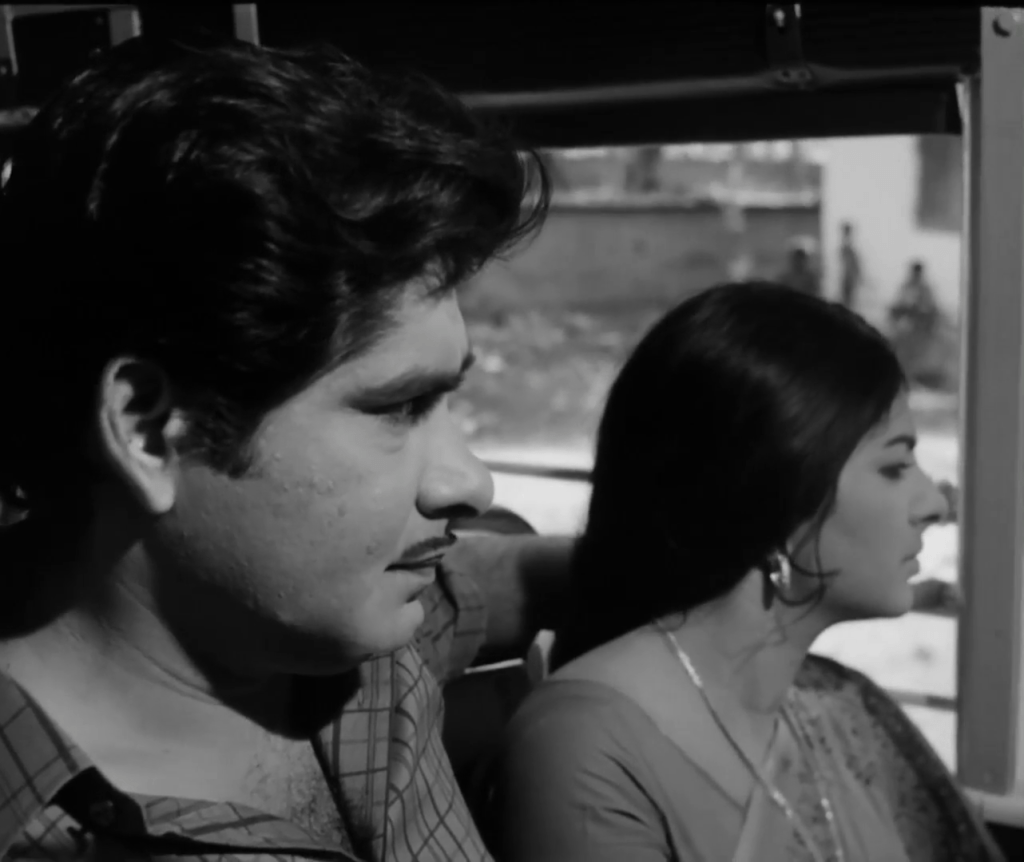
Adoor Gopalakrishnan’s debut feature Swayamvaram (1972) is a stark melodrama that marked the beginning of the Malayalam New Wave, an adjunct of India’s Parallel Cinema movement. The film opens with an extraordinary six-minute, dialogue-free sequence aboard a moving bus in Kerala. Shot in a verité style, the camera roves among passengers before settling on the protagonist, Viswam (Madhu) and Sita (Sharada), two lovers who have eloped. This observational approach, with its semi-documentary tone, evokes the French New Wave more than Italian Neorealism, despite frequent comparisons. The liberated camera style even recalls Mrinal Sen’s Calcutta Trilogy, signalling a bold cinematic experiment.
As the narrative unfolds, the couple’s socio-economic descent is rapid and relentless. They move from a fancy hotel to a modest lodge and finally to a slum. Adoor frames their romance as elemental and natural, even parodying mainstream Indian melodramas in an early montage of the couple flaunting their love on the coast. The camera remains strikingly free in these early passages, arguably the most liberated in Adoor’s oeuvre, before gradually adopting a stillness and restraint that would define his later work. The film feels like an extended experiment in cinematic syntax: roving camera movements, high-angle framings, and deep-focus compositions. Yet none of this seems forced; even today, the technique feels fresh and innovative, revealing a technical mastery rare for a debut.
In the slum, Viswam finds work as a lecturer while nurturing aspirations of becoming a writer. His manuscript is rejected by a newspaper editor for being ‘too sentimental’, a moment that underscores his fragile ambitions. Meanwhile, Sita, educated and holding a university degree, appears increasingly confined, gazing out of windows at a world beyond her reach. Her attempt to secure a sales job fails when she learns of an exorbitant deposit requirement, a bitter reminder of systemic barriers and her concealed superiority in education compared to Viswam. As Sita becomes pregnant, Viswam loses his job. Regret sets in; severing ties with their families has left them without a safety net. Adoor subtly weaves in political undertones: a brief sequence of workers marching for reinstatement hints at themes of protest and resistance, recurring motifs in Malayalam Parallel Cinema of the era; seen in films like Aravindan’s Uttarayanam (1975) and Backer’s Kabani Nadi Chuvannapool (1975), culminating in John Abraham’s Amma Ariyan (1986).
Viswam eventually secures a clerical job at a sawmill, but guilt gnaws at him when the dismissed former clerk (Gopi) confronts him, inadvertently exposing the exploitative practices of the mill owner. Sita gives birth to a daughter, but tragedy strikes: Viswam falls ill and dies, leaving Sita bereft. In the haunting final sequence, Sita refuses to return to her parents and remains in the slum with her child. Adoor cuts to the door from Sita’s POV, implying the smuggler, introduced earlier, may now enter, leaving the film on a note of deep moral ambiguity and existential despair.
Partly financed by the Film Finance Corporation and distributed by Chitralekha Film Cooperative (founded by Adoor), Swayamvaram launched the Malayalam New Wave. It remains a landmark of Indian cinema; an audacious debut blending formal experimentation with social critique, and a moving deliberation on choice, freedom, and the crushing weight of circumstance.
 Movie Mahal