* * *
Released in 2009, director Laxmikant Shetgaonkar’s Paltadacho Munis could arguably be situated as part of a post-Parallel Cinema cycle of films, a sort of hangover from the mid to late 90s era, since it is a work that explores caste, gender and religion in a rural milieu with a brilliantly sharp eye for socio-political allegory.
This NFDC production is set in the secluded forests of Goa. Vinayak (Chittaranjan Giri), a subdued forest warden is recovering from the loss of his wife, clinging on to fragile memories of their time together. Vinayak works for the Indian Forest Service and his main aim is to stop people from butchering the forest specifically the illegal cutting down of trees and blatant timber poaching, all of which is a near impossibility in the face of a traditional and ancient power structure in which the upper caste circumvents and exploits the system for their own greed and self-aggrandisement. The pretext the upper caste offers in attempt to mask the consolidation of their old age grip on power is the proposal to erect a temple. At first, the proposal appears to divide the village but over time the temple becomes a source of coercion, a way of pacifying anyone who disagrees with the status quo while expunging any dissent.
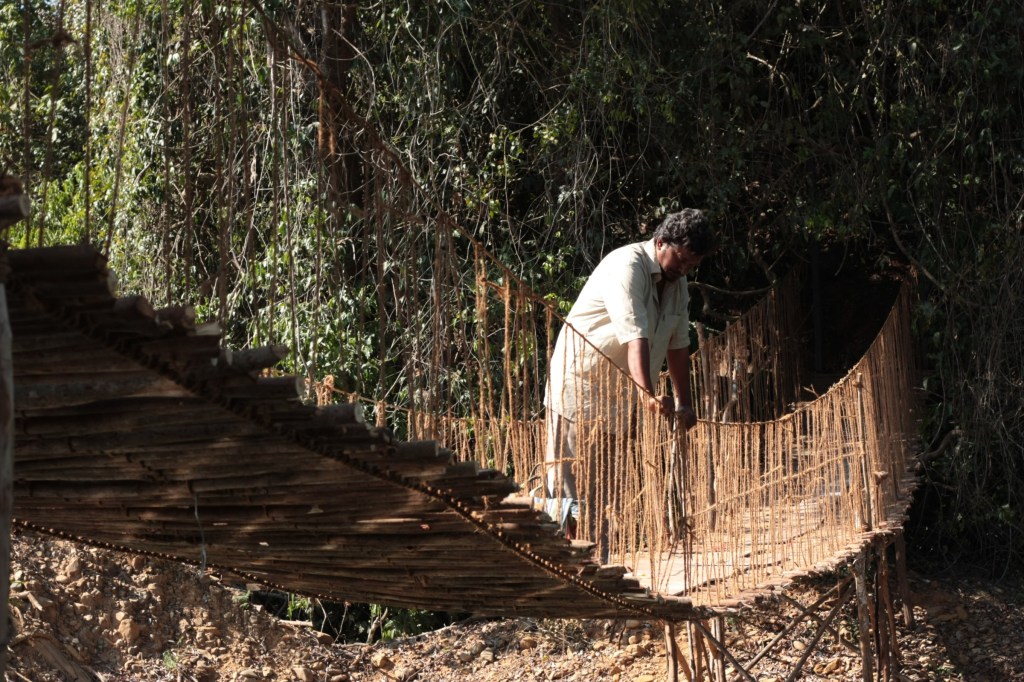
With the construction of the temple, the caste structure becomes altogether entrenched. However, Vinayak is one of the few to question the motives behind the construction of the temple, and his refusal to participate in its construction points to a disdain for the instrumentalisation of religion to essentially brainwash the villagers. Vinayak’s separation from the village is symbolised in the bridge that connects the land on which he lives to the village, emerging as a continuous visual metaphor for transgression, severance and change. Moreover, the bridge connects two different worlds; Vinayak’s world appears far more progressive, modern in contrast to the religious orthodoxy that rules over the village.
The forest is also home to a so called ‘madwoman’ whom Vinayak befriends and provides shelter and food for, ultimately taking pity on her. As we come to discover, those who are labelled as insane are ostracised from society, as is the woman, who is uniformly demonised by the village as someone who brings bad luck to others. It is also more than likely the woman is lower caste too since the contempt with which she is treated echoes similar on-screen caste representations from the past. The bundle the woman clings on to offers a symbolic link to a child she may have lost and her silence and segregation points to an undisclosed trauma which is arguably historical, structural and systemic that is both based in a gender and caste-based violence.
However, Vinayak’s support for the woman emerges as just more than pity, transforming into a companionship built on kindness and acceptance, and eventually a child. Of course, the villagers are outraged and incensed when they find out, much of it instigated by the upper castes, arguing the relationship transgresses the laws and codes of the village and deeming it to be a perversion. In leading a violent assault on Vinayak’s house, they victimise the woman sending her fleeing into the forest with her child, and the assault comes to articulate something malevolent, mob law and ferocious about the ways in which religion and tradition are often weaponised in the service of demagoguery.
Vinayak and his wife’s reunion at the end and in the dead of night is a muted one but essential in demonstrating the intercaste bond they have nurtured is strong enough to transcend the flow of history, to push back against the horrors of caste discrimination, all of which is anchored quite poignantly in Vinayak’s destruction of the bridge. The severing of the ropes that holds the bridge together becomes a metonym of choosing to abandon the world of religious orthodoxy, caste prejudices and corrupt government structures. Perhaps it is a romantic choice but one filled with an undeniable sanguinity about what could be rather than what is.
 Movie Mahal