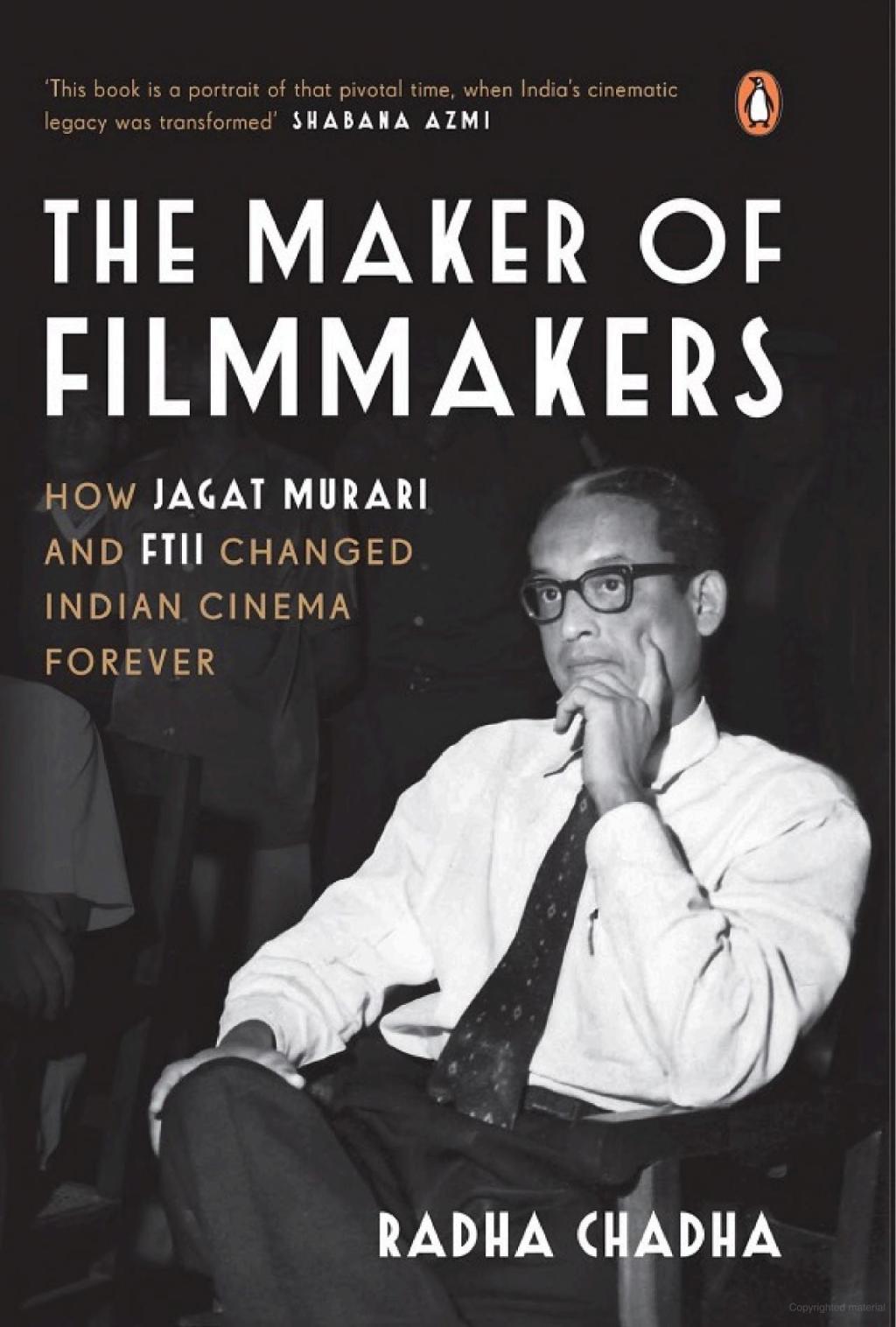
Radha Chadha’s book about her father, Jagat Murari, is everything I expected it to be. It is deeply personal, something of a love letter, and although it isn’t an autobiography of Murari, it incidentally comes to read very much like one. That suits me fine. Chadha had unrivalled access to his life and archives, and it shows. Nor is any of it out of reach. Her prose is accessible and conversational, so anyone curious about how filmmaking developed as a practice in India can enter this world with confidence and come away satisfied. Murari’s journey is, frankly, bonkers in what he accomplished across many decades, from the 1940s through to the 1970s. He played a key role in the development of India’s film institute, did much to elevate the status of film as an art, and, most importantly, helped nurture generations of new film artists. He was no opportunist, nor someone swept along by the tide of change. He was on a precise mission; to let his passion for film infect India’s cultural mindset, and all for the better. It strikes me as strange that Murari’s achievements remain so little known. When I was researching my own book on Parallel Cinema, I came across the influence of B. K. Karanjia on the birth of the movement in the late 1960s and early 70s, yet Murari’s name hardly came up at all.
Obviously, Chadha’s book plugs the gap, but I suspect this is one of those cases where everyone in the film industry knew about Murai and no one bothered to tell his story. Studying at film school in America, working on the sets of Hollywood studio productions, and then making documentaries with the Film Division in India are just a few of his accomplishments, and Chadha charts each of these milestones with energy, charm and enthusiasm. The most instrumental period was his time at the newly established film institute in Pune in the 1960s, where he became something like the centre of the filmmaking universe, shaping the discipline and practice of making films while staying close to film policy. Coming at this from a Parallel Cinema perspective, what interested me most was Murari’s often overlooked role at the Film Finance Corporation. In the late 1960s, he pressed those handing out film loans to keep one eye on the new and talented recruits emerging from the institute. For me, this opens up the discourse and history around the birth of Parallel Cinema, situating Murari’s influence more fully within the broader narrative of that seminal moment in India’s film history. Murai also encouraged experimentation at the institute, and in doing so, perhaps inadvertently, nurtured two critical strands of alternative Indian cinema: the avant-garde and the documentary form, both fundamental to Parallel Cinema across four decades.
What Chadha also captures so vividly is how much Murari was up against. His fight with the state may well be the defining characteristic of his story. He battled not only the state’s indifference but also the meagre funds available to the film school, and he made the most of his own networks, drawing guest speakers from the film industry. Having been to film school himself and trained as a documentary filmmaker, he understood the challenges of making films in India, yet he took many risks in the name of elevating the technical, thematic and aesthetic standards of Indian filmmaking. Where this comes through most clearly is not only in the growth of the FII into the FTII, but in the breakthrough of 1969 and the emergence of Parallel Cinema. But it wasn’t only Parallel Cinema. The flood of talented actors, directors, cinematographers, editors and other film artists who emerged from the FTII carried their specialist training into every corner of the Indian film industry.
Murari’s story is one of a man who built the conditions for a generation to flourish, often against the odds, and whose influence runs through Parallel Cinema and the wider industry alike. Chadha’s loving, accessible book finally gives him his due, and it leaves me wondering why it took so long.
The Maker of Filmmakers: How Jagat Murari and FTII Changed Indian Cinema Forever by Radha Chadha (Penguin, 2025)


Leave a Reply